Welcome to Jinan KingM Machinery Co., Ltd


Exploring the Selection of Auxiliary Gases for Fiber Laser Cutter Machines & Common FAQs
Why do fiber laser cutters need auxiliary gases?
1. Achieve a clean cutting edge. The high-pressure gas blows away molten metal and prevents slag buildup, resulting a cleaner, smooth and bure-free cut.
2. Enhance the cutting process. Different gases serve different operational purposes. For example, Oxygen boosts the cutting capability in thicker metals. Inert gas like Nitrogen or Argon keep the cutting edge clean and prevent oxidation.
3. Cool the workpiece. During cutting, the auxiliary gas carries heat away from the cutting surface, helping control the heat-affected zone (HAZ) and preventing warping.
4. Protect the laser cutting head and lenses. A continuous steady flow of auxiliary gas prevents debris from contaminating the optical elements, extending the lifespan of your consumables.
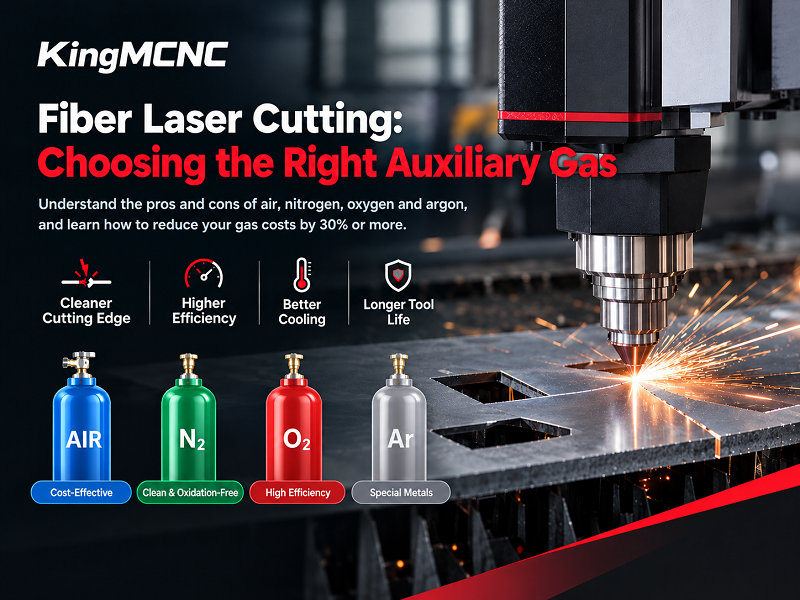
Comparing Auxiliary Gases: Air Vs. Nitrogen Vs. Oxygen Vs. Argon
Compressed Air
Pros: Highly cost-effective. It can be supplied directly by an on-site air compressor, reducing the consumable parts.
Cons: Produces a sightly oxidized, yellowish tint on the cutting edge. Cutting capability and processing efficiency are generally lower compared to pure Oxygen or Nitrogen.
Ideal Application: Aluminum, aluminum alloy, thin Low Carbon Steel (under 3mm).
Nitrogen (N2)
Pros: Delivers oxidation-free cutting, resulting in a bright, shiny and rust-free edge. Finished workpieces can be directly used for welding or painting without secondary grinding or finishing work.
Cons: Requires high-purity gas and high flow rates, which significantly increase hourly operation costs compared to air.
Ideal Application: Stainless steel, galvanized/electroplated steel, brass, aluminum, and aluminum alloy.
Oxygen (O2)
Pros: Acts as a combustion catalyst, offers intense additional heat that significantly improves the cutting efficiency, speed and maximum thickness capabilities.
Cons: The thermal oxidation process makes yellowish or black edges, which may require secondary processing before painting or welding.
Ideal Application: Carbon steel, thick mild steel (over 3mm), hot-rolled steel, and cold-rolled steel.
Argon (Ar)
Pros: As a highly inert gas, Argon provides protection against oxidation and chemical reaction during laser cutting process.
Cons: High cost, make it unviable for standard daily operations. Typically reserved for special metals.
Ideal Application: Exclusively for processing high-value or highly reflective special metals such as titanium, titanium alloy, and medical materials.
The Key Principles for Selecting Auxiliary Gas
Choose the right assist gas can reduce the operation costs, finish quality and balance the materials requirements.
For Carbon Steel, the optimal choice is Oxygen (O2). it boosts the efficiency and lowers cost per part.
For Stainless Steel & Aluminum Alloy, Nitrogen (N2) is industry standard. It prevents oxidation, ensuring a smooth, clean, burr-free and pieces that ready to weld.
For Thin Sheet (Under 3mm), if the yellowish edges are acceptable, the compressed air is the most cost-effective choice.
How To Cut Fiber Laser Auxiliary Gas Costs by 30% or More
Auxiliary gas is one of the biggest costs in fiber laser cutting. By choosing the right gas or adjusting the settings, you can significantly lower your costs without losing the cutting quality.
1. Choose the Most Cost-Effective Gas for the Application
• Oxygen vs. Nitrogen for Carbon Steel: While cutting low-carbon steel, if your downstream application tolerates a dark, oxidized edge, Oxygen is more economical than Nitrogen while delivering faster speed on thicker plates.
• Compressed Air for Post-Processed Parts: If parts are scheduled for painting, powder coating, or plating after cutting, minor edge yellowish won't affect the final finish. Switching to high-pressure compressed air can reduce gas costs by 80%-90% compared to bottled or liquid gas.
2. Optimize Gas Consumption & Equipment Efficiency
• Perform a Pressure Curve Test: Most manufacturers' default pressure settings are often 10-20% higher than necessary. After receiving the machine, we recommend you perform a pressure curve test: gradually dial down gas pressure until the cut edge begins to show dross, then increase the pressure by 5%. This is your optimal, cost-effective pressure setting.
• Switch to On-Site PSA Nitrogen Generation: If you Nitrogen consumption exceeds 5,000 m³ of Nitrogen, investing in an on-site Pressure Swing Adsorption (PSA) generator can pay for itself within 1-2 years, eliminating the need to purchase Nitrogen.
• Protect Optics with High-Quality Air Filtration: When using a shop air, pair your compressor with dedicated dryer and water filter keeps compressed air clean and dry. Moisture in the air rapidly ruins protective lenses and nozzles. KingMCNC recommend testing your air system the dew point weekly, and maintaining it at -40 °C for optimal condition.
FAQs about Auxiliary Gases for Fiber Laser Cutting Machines
1. Can stainless steel be cut using compressed air as the auxiliary gas?
Yes, but the cut edges will oxidize. The oxygen present in compressed air breaks down the protective chromium oxide layer on stainless steel, which is the primary barrier responsible for its corrosion resistance. While cutting with compressed air significantly lowers the costs, the finished edges will rust if exposed to water, weather, or chemical unless secondary finishing is applied.
2. Can an air compressor damage my fiber laser cutter?
It depends on the air treatment system. Standard compressors delivering unconditioned air will damage cutting optics due to oil, moisture, and particle contamination. However, An industrial air compressor equipped with an air dryer and a water filter protects internal laser head and extends protective lens lifespan.
3. When cutting stainless steel, how do I choose the right Nitrogen purity?
• 99.95% (4 Grade): Sufficient for standard 304 and 316 stainless steel where edges will not be welded or highly visible. The cutting edges will appear light silver-grey. If the parts will be polished or
• 99.995% (4.8 Grade): Required if parts will be welded, polished, or exposed to corrosive environments. High-purity Nitrogen ensures full weld integrity without secondary grinding.
4. Why is Nitrogen consumption significantly higher than Oxygen consumption?
Nitrogen cutting requires higher pressure to melt and blow away molten metal, requiring 2 to 4 times higher operating pressure (14-20 bar) and nozzles are larger than Oxygen cutting. In contrast, Oxygen relies on a chemical reaction (combustion), requiring much lower pressure (1-5 bar).
Note: KingMCNC offers high-efficiency, low consumption nozzles, that can significantly reduce the consumption and optimize gas dynamics.
5. How do I verify that my gas supplier is delivering the correct purity?
Gas purity can be verified visually during the cut:
• Nitrogen on Stainless Steel: If Nitrogen purity drops, the cut edge will display yellow, brown, or blue oxidation spots instead of a clean, silver finish.
• Oxygen on Carbon Steel: If Oxygen purity drops 99.5%, cutting speeds declines noticeable and heavy slag forms along the bottom edge.
6. Can I use different auxiliary gases within a single cutting job?
Yes. Advanced CNC control software like Cypcut allows multi-stage gas parameters within the same job layer. For example, when cutting thick stainless steel, you can set the machine to pierce using Oxygen (for rapid, low-taper piercing) then switch to Nitrogen for cutting pass (for clean, oxidation-free edges).
This lets you use a small amount of Oxygen for fast piercing while achieving clean cutting edges with Nitrogen. Contact KingMCNC's sales team to ensure your machine runs at optimal conditions and performs at its best.