Welcome to Jinan KingM Machinery Co., Ltd


Fiber Laser Power vs Cutting Thickness: Parameter Selection Guide (2026 Edition)
When investing in a CNC fiber laser cutting machine, the most critical decision is selecting the right power. Choosing too little wattage restricts cutting capability, slows down feed rates, and leads to poor edge quality. On the other hand, over-specifying wattage unnecessarily increases your initial capital expenditure (CapEX) and ongoing operating costs.
This guide helps you select process to identify the ideal wattage in seconds without complex technical analysis.
Production (Commercial) Maximum Thickness vs. Absolute Cutting Thickness
Before selecting your laser wattage, it is vistal to understand the difference between production cutting capacity and absolute physical capacity:
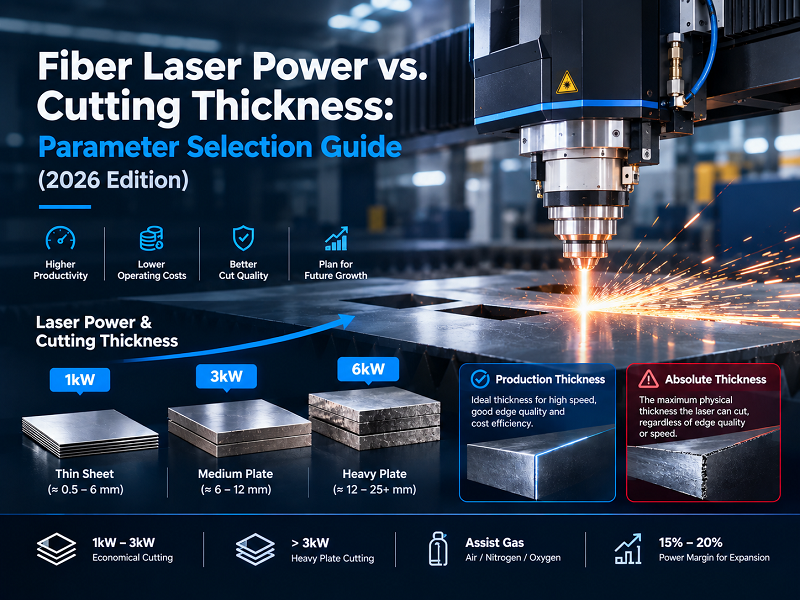
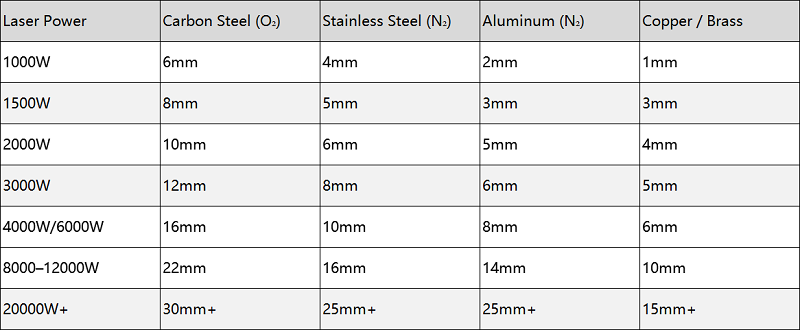
• Production (Commercial) Maximum Thickness: The ideal material thickness at which the machine maintains high speed, smooth edge quality, efficiency, and the maximum cost-effective throughput. Base your purchasing decision on this rating for standard daily output.
• Absolute(Maximum) Physical Thickness: The absolute thickest plate the laser wattage source can pierce and cut through, regardless of edge taper, dross, or slow cutting speed. This capacity is intended only for occasional, non-standard job, not continuous daily producing.
Laser Wattage & Thickness 3-Seconds Quick Selection Guide
3 Reasons to Match Laser Wattage to Your Production Maximum
Based your laser wattage selection on your daily production (commercial) maximum thickness rather than occasional limits. Here are three key reasons way:
• Avoid Over-Specification and Excessive OpEx. More wattage is not always better. Operating a high-power machine primarily for thin sheets cutting drives up equipment costs (CapEx), increases maintenance costs, and consumes more auxiliary gases than necessary.
• Prevent Under-Specification & Bottlenecks. Selecting a lower-wattage machine to save on initial purchase price leads to slow cutting speed, or even fail to pierce and heavy slag buildup. The resulting burr edges require secondary grinding, increasing labor costs and creating throughput bottlenecks on your shop floor.
• Target Peak Cost Efficiency. Every wattage level has its sweet spot, delivering the best cut quality at the lowest cost. Low to middle wattage laser excels at high-speed cutting for thin-sheet, while high wattage machine is built for large-volume, heavy-plate fabrication. Matching wattage to your primary workload, and you'll get the job done at the lowest cost.
Quick Model Selection:
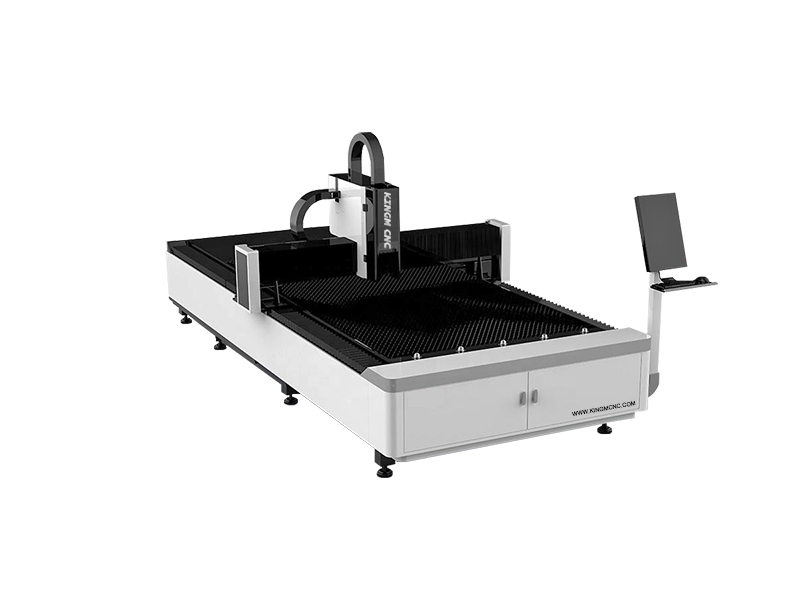
• 1000W-3000W Range: If 1000W-3000W covers your daily processing needs, choose standard the economical model, the KINGMCNC KM-F3015E.
• Above 3000W: For heavy-plate cutting requiring more than 3000W, select the high capacity KM-F3015L.
• Sheet & Tube Processing: If your shop requires integrated tubing cutting capability, contact KingMCNC sales team for customs quote.
3 Key Factors to Avoid Misallocated Capital Investment
• Productivity & Processing Speed. The laser wattage directly dictates cutting capability. A 3000W fiber laser cuts at 2m/min for 4mm carbon steel. In contrast, 6000W cuts twice as fast. For high-volume operations and tight manufacturing deadlines, investing in higher wattage machine increases productivity and lowers costs.
• Operating Costs. Electricity, auxiliary gas and consumable all scale with laser wattage. High-power machines utilize a more powerful laser generator, a larger chiller, and higher-power electronics, driven up electricity costs. They also require higher gas pressure and flow, increasing gas consumption. Avoid blindly choosing high wattage, match it to your actual processing needs.
• Future Business Expansion. Consider how much your company may expend for the next 2-3 years. If you plan to expand into heavier fabrication contrasts, select a laser source with a 15%-20% power margin to accommodate future fabrication requirements.
FAQs: Common Questions About Choosing Laser Power
Q1: Can a 3,000 W fiber laser cut 20mm carbon steel?
Yes, but only as absolute physical limit. Using Oxygen as the assist gas, a 3,000 W laser can pierce and cut 20mm carbon steel. However, 20mm exceeds its recommended daily capacity. Cutting at this maximum thickness may produce a severe edge taper, and slag buildup. For consistent daily production quality, choose your laser wattage based on your production(commercial) maximum thickness. About the commercial maximum thickness, see above for details.
Q2: Is higher laser power always better?
No. Select a wattage that far exceeds your needs adds your initial capital expenditure (CapEx) and increases maintenance costs, lowering return on Investment (ROI), lengthen payback period.
Q3: Air cutting vs. Nitrogen cutting
• Air cutting: low cost, because gas is supplied by on-site air compressor, but minor oxygen levels in the air leave a slightly oxidated, and yellowish edge. It's ideal for parts scheduled for painting, powder coating, or hidden assembly.
• Nitrogen cutting: Produces oxidation-free, bright, shiny, rust-free edges, ready for welding or 34making it higher hourly operating costs (OpEx) than air.
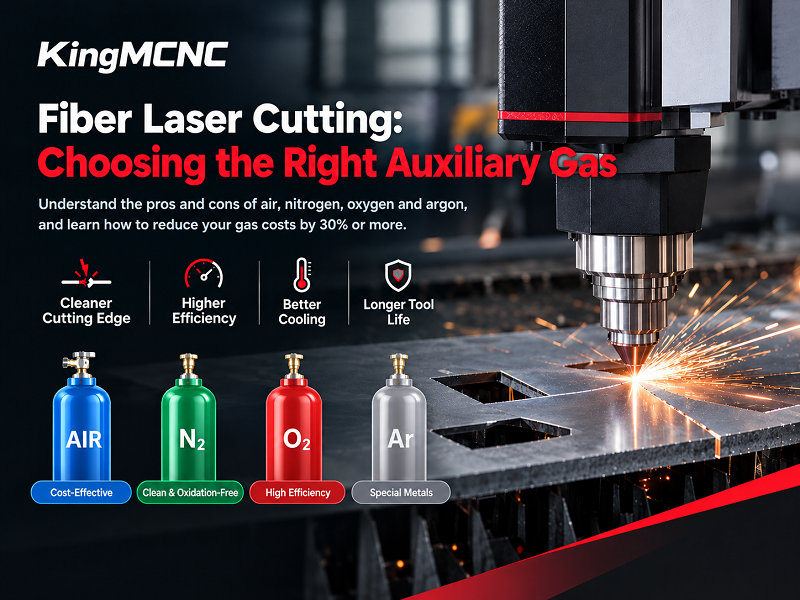
Choose based on edge quality and investment cost. Click here for more details: Exploring the Selection of Auxiliary Gases for Fiber Laser Cutter Machines & Common FAQs
Summary: How to Choose Right Power
• Confirm your daily maximum cutting thickness.
• Leave a power margin for future plans.
Still unsure? Click here to contact KingMCNC sales team for parameter details and recommendations.